
Schools for Concentrations
In formulating the pedagogy, we collated some of the Micro-contexts under Schools for Concentrations. These schools will lend their thematic focus to your learning journey
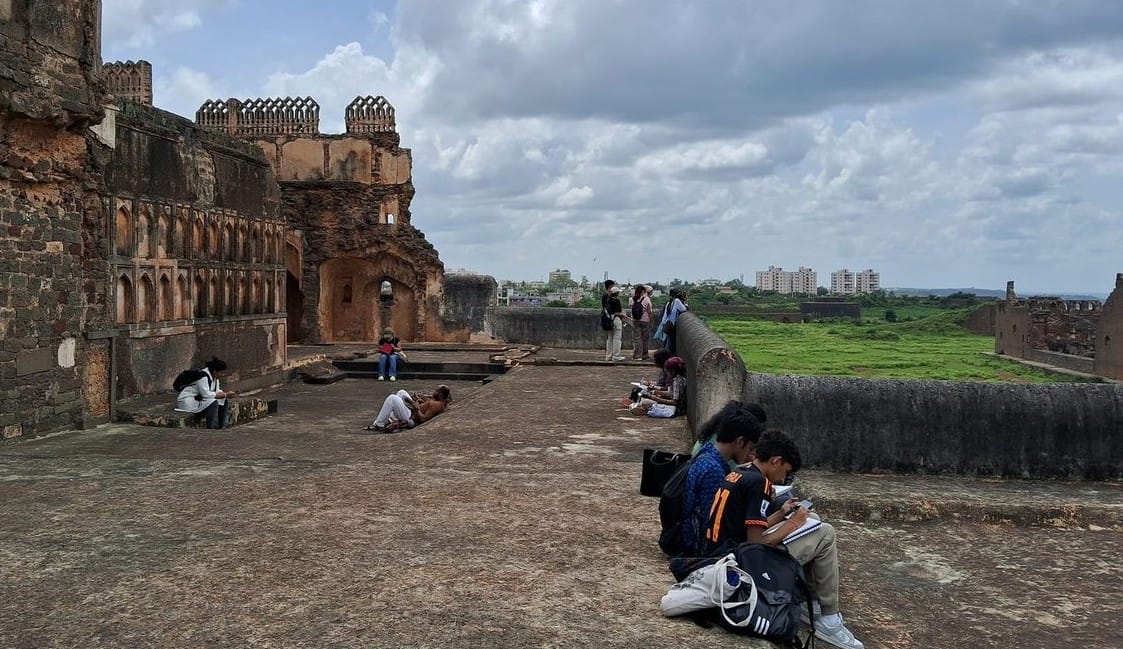
Concentrations serve as the infrastructuring framework for the schools to position themselves and shaping the curriculum, learning and pedagogical structures. These concentrations are not merely academic specialisations but they represent the transdisciplinary possibilities of learning and engagement designed to understand, foster, and collaboratively respond to complex real-world situations held within and across micro-context.
In our decade-long engagements with various places, we explored hundreds of “Micro-Contexts”. Each micro-context represents an extremely specific and unique aspect of the region, some examples include - Embroidery in Sindhol Thanda, The world of Osman Gunj Market, Fig Varieties in Bidar, The Bidri Art made in Bidri Colony and several hundreds.
Your journey to building a place-based practice begins from our concentrations. Each school is anchored around key questions that guide us to design the curriculum and curate learning modules. You will acquire the capabilities required for a place-based practice such as,
- Setting clear boundaries for your learning and practice - know exactly when, where and what to do
- Centering the experiences of local knowledge keepers in order to develop a collaborative practice
- Engaging through applied learning rather than simply observing
- Drawing connections between local practices and broader contexts
- Maintaining a repository of learning and evolving practice using multiple media and methods
- Balancing depth with intensity through immersive engagement
"Learning can happen from the past and the present. Each place has its own origin and geographic context."
Our Schools
Our pedagogy is grounded in place-based and practice-led approaches, embedded in public which are the people, culture and practices. To break away from the enclosed and distant structure of a coloniser pedagogy, we approach learning as a weaving of the social, cultural and natural worlds of the people.
Our learning values
Place-Based
Place-based means to be deeply rooted in the unique social, ecological, historical, and political realities of the places from which they emerge
Learning can happen from the past and the present. Each place has its own origin and geographic context, so theories and methods can be universal. Place-based approach is rooted in geography, community and culture. As a school, we emphasise learning with the people and with the place.
Read more about the places we learn in at Places
Learner at the Center
We designed a few learning modes, where this can be facilitated. Learning modes open up diverse avenues, environments and approaches for learners to engage with concepts, practices, people. It can be through hands on experience, critical dialogue or even observation. They contain not only formal structured methods but also community base and self-directed learning. The five learning modes which has activities which are of participatory nature has been helping learners and educators to engage deeply and work collaboratively and learn meaningfully by doing.
You can read more about our Pedagogy here
Transdisciplinarity
Transdisciplinary: creating a unity of intellectual frameworks beyond the disciplinary perspectives. - Alexander Refsum Jensenius,
Transdisciplinarity is an learning approach which will braid knowledge systems, skills, fields and values. The approach leads to collaborations happening across disciplines which eventually leads to exchange of knowledge. From the educators to learners to collaborators, we can find people who live across disciplinaries.
Transdisciplinarity is a relatively young approach, the word was brought into usage by Jean Paget in 1970.(Basarab Nicolescu, 2010) This became a new space of knowledge without stable boundaries between the disciplines.
The process of transdisciplinarity becomes like an orchestra, where multiple musicians are playing multiple instruments at the same time, and the result is a symphony which we hear.
Re-imagine Development
For the imaginations will be happening hand in hand with the people of the place, the pedagogy helps one to orient to the axiom of ‘support over solve’.
The pedagogy also allows learners and facilitators to explore alternative pathways and reimagine what locally rooted development looks like.
The Kalyana-Karnataka region has been called as underdeveloped and backward region with the measures of various indicators. Beyond those indicators is where the ecology, historical monuments, rich cultures and diverse communities who speak multiple languages from Kannada to Dakkhani hail from.
Development has historically been about creating solutions by people who are in the top of the system to problems of the people.
Practice-based Learning
The process of understanding a concept through practice brings thinking and doing as integrated action.
Learners engage with methods, theories, and tools not just by reading but most of the time by doing. Building has been a inherent quality of human beings, we were always very active and responsive to materials found naturually.